Safika’s Chairman resigns from Standard Bank Group to develop opportunities at Safika

Safika’s chairman, Mr. Saki Macozoma, has announced he is stepping down as chairman of insurance giant Liberty Holdings and deputy chairman of Standard Bank to develop opportunities available to Safika.

Mr. Macozoma is a major shareholder in Safika Holdings, which is in an expansion phase. Through its subsidiary Safika Resources, it has successfully entered the South African minerals and resources sector with its new Tshipi Borwa manganese mine in the Northern Cape and is now conducting a feasibility study into a second manganese mine in the area.

The Safika group is expanding internationally, having concluded significant recent transactions in Australia and Singapore.

“I enjoyed my 15 years with the Standard Bank group very much and I feel that I am leaving at a time when it is well positioned with a clear strategic vision and excellent prospects,” said Mr. Macozoma. “However, Safika is growing fast and is presented with opportunities that it would be short-sighted not to take advantage of and so I have decided to devote my energy there. The close working relationship that Safika has with Standard and Liberty will continue.”

Standard and Liberty are significant shareholders in Safika, which is one of their BEE partner companies. Safika also owns stakes in both Standard Bank and Liberty.

Moss Ngoasheng, Safika’s chief executive, stressed the company will remain invested in the Standard Bank Group. “Safika has no intention of selling Standard Bank or Liberty Holdings shares which are not subject to prior financial arrangements and consequently Safika will continue to remain a substantial shareholder in both institutions; we are long-term holders of both,” he said.

Cause for celebration at Safika’s Ntstimbintle Mining

Ayanda Mjekula appointed to Safika board

Mr. Saki Macozoma, Safika’s chairman, has announced the appointment of Ayanda Mjekula to Safika Holdings’ board of directors. Mr. Mjekula formerly held many senior positions in banking, including being a director of Standard Bank and has experience in areas of credit, retail operations, public sector banking and social strategy. After opting for early retirement 2007, he became chief executive of The South African Supplier Development Agency (SASDA), a state-funded supplier development agency.

Mr. Mjekula has also played a prominent role in the energy industry in which he served as chairman of the Central Energy Fund (CEF), chairman of the National Committee of World Petroleum Council, chairman of the South African Agency for Promotion Petroleum Exploration and Exploitation and as a director on the PetroSA Board.

He is a former chairman and former acting chief executive of Ubank and is chairman of the Coega Development Corporation audit committee.

He is chairman of the University of Fort Hare Foundation, chairman of the Grahamstown National Arts Festival, and a member of the executive committee of the Golden Lions Rugby Football Union team.

I am humbled by the vote of confidence the board and shareholders of Safika Holdings have given me,” said Mr. Mjekula. “To serve on a board consisting of prestigious professionals with impeccable credentials is truly an honour. The diverse nature of Safika’s investment portfolio is both exciting and challenging and I will do my best to in what I believe is a conducive environment.

Safika pays tribute to Nelson Mandela

mandela-3

In years to come it is entirely possible that the world will view Nelson Mandela as one of the greatest men who ever lived. He led the people of South Africa to freedom from tyranny and then, through the virtues of tolerance and forgiveness, won over his persecutors and created a society in which both white and black prosper.

Before Mandela, black people were not allowed to own companies, so without him our company would not even exist. In the world before Mandela it would have been inconceivable that black people could own and run a major investment house. Mandela made it possible.

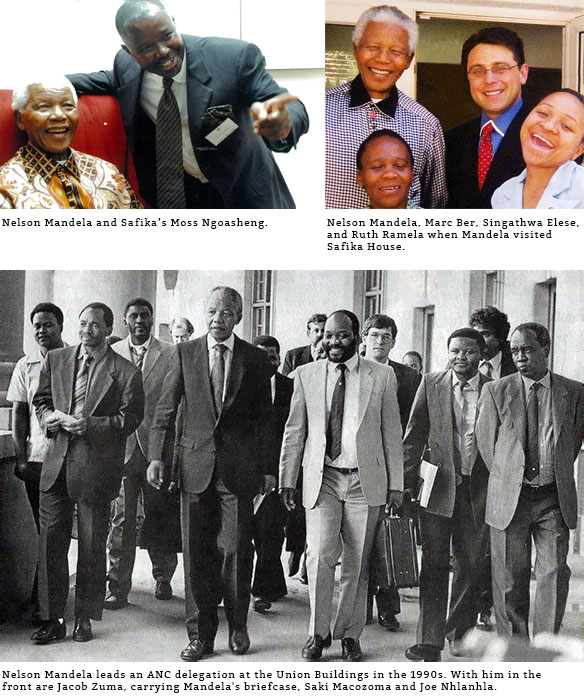
Three Safika directors and former shareholder, the late Soto Ndukwana, fought side-by-side with Mandela for freedom and were imprisoned with him on Robben Island; Moss Ngoasheng served seven years, Saki and Soto served five years and Richard served 11 years. Mandela mentored Saki and Moss during their imprisonment and both acknowledge the huge debt they owe him for his moral and political guidance. “It was Madiba’s personal intervention that led me to become an economist, which in turn led to me becoming Safika’s chief executive,” says Moss.

He recalls: “While I was in prison, I went to see Madiba to tell him that I wanted to study politics. He shook his head and said; ‘why don’t you study economics instead; in the future we are going to need men like you to be our economists’.” Then the great man handed Moss his personal Economics 101 notebook and told him to get started.

“That was it,” said Moss. “I became an economist and when democracy came I worked in the Presidency as chief economics advisor. Every time I would go into Madiba’s office he would laugh and remind me of his tattered old notebook. I would remind him how difficult it was to read his notes because he had terrible handwriting.”

Saki Macozoma recalls his first meeting with Madiba: “Meeting Nelson Mandela in November 1977 was like the epiphany on the road to Damascus for a young adult like me. I was young and angry. He was wise and caring. I had no idea that less than fifteen years later I would be writing speeches for a free Mandela and participating with him in the unfolding of a great historical moment, freedom for South Africa.

“When freedom came it was time to build South Africa. Safika Holdings was to become our modest but vital contribution to the reconstruction of the South African economy. At this sad moment we celebrate Madiba’s legacy through Safika’s contribution to the economy of South Africa. In Safika all South Africans have found a home in which they can use their talents to create wealth that all of us can share.”

Richard Chauke worked as a director of sport on Robben Island and recalls watching him play tennis. “He was pretty good,” he recalls. “I was not one of those close to Mandela on the island but like everyone else I placed my trust in him. He played an enormous role in my life because he was the glue that held us together and the values I hold today are the values I learned whilst on the island and those values came directly from Madiba.”

Madiba once visited Safika House; chief financial officer Marc Ber recalls that first a security team swept the building and then told everyone to stay in his or her offices when he arrived. “We did as were asked,” he said, “but when Madiba came walking in he stopped and said hello to everyone. In moments we were posing for pictures with him and being treated as if he had known us for years.”

We at Safika like to think that we honour Mandela by living as he would like us to do. We have built a flourishing business that we use to develop South Africa for the benefit of its people. We are investors in and responsible for multi-billion rand ventures that provide employment, bring tax revenues to the country and add to our country’s international reputation. Everything we do in business is possible only because Nelson Mandela and his comrades made it possible.

Safika owes another debt to Madiba; we learned our ethics on Robben Island taught to us directly by Mandela. He taught us not to dwell on the wrongs of the past but instead to focus on building the kind of society we would be happy to live in. Safika follows Madiba’s moral guidance; we will have no truck with corruption, we are honest in our dealings and we are always aware that our number one priority is help make South Africa economically stronger, in a way that benefits the people.

Thank you Madiba from all of us.

Saki Macozoma, Chairman
Moss Ngoasheng, Chief Executive
Saki Macozoma farewell dinner at Wits

Safika helps young people with internship and mentoring

First train arrives at Tshipi Borwa

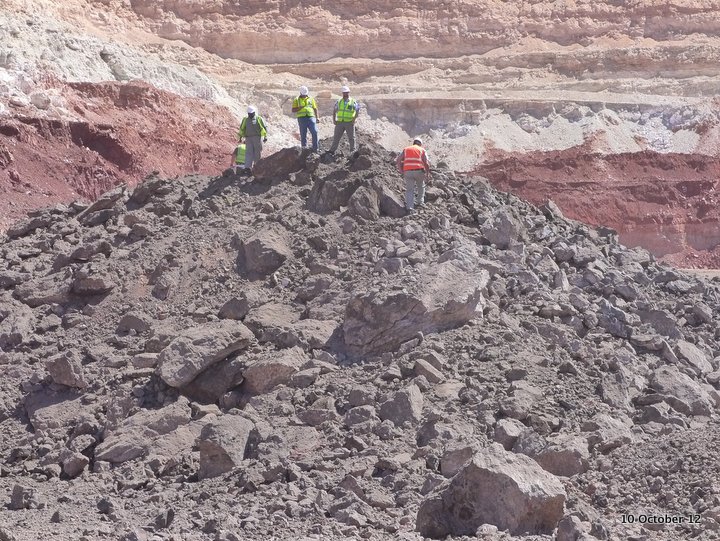
Tshipi Borwa, our new manganese mine in South Africa’s Northern Cape, has reached another milestone. The first train has arrived at the mine and is now being loaded with the mine’s first shipment of manganese destined for the Far East.

Tshipi é Ntle’s Tshipi Borwa mine’s first manganese ore.

Tshipi é Ntle’s Tshipi Borwa mine in South Africa’s Northern Cape has mined its first manganese ore.

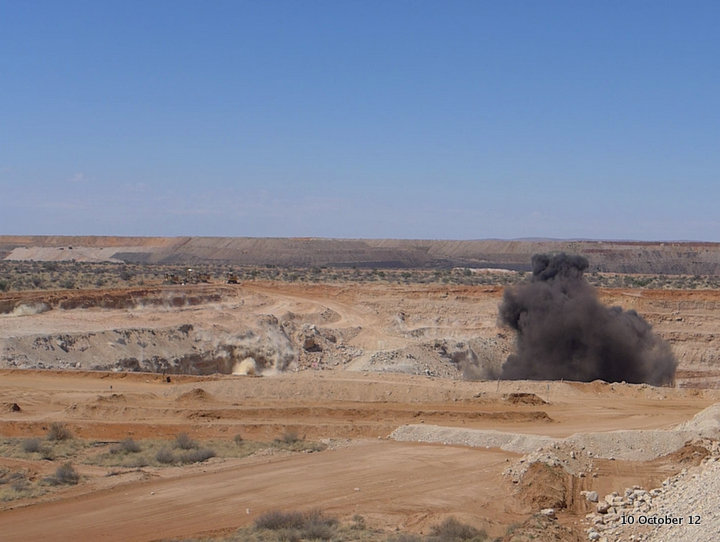
It took 11 months of continuous 24 hour-a-day operations to shift the waste rock overlaying Tshipi’s ore resources. Tshipi blasted its first ore on the 10 October, several weeks earlier than planned. Ore loading commenced within hours.

Justin Pitt, managing director of Safika Resources, said “We are very pleased with the progress of Tshipi to date and we are now stockpiling the manganese to be loaded on to the first train that will leave the mine for Port Elizabeth in November. From there it will be shipped to the Far East in December.”


Saki Macozoma has been honoured by UNISA

Safika’s non-executive chairman Saki Macozoma has been honoured by the
University of South Africa (UNISA) which has made him and former president Nelson
Mandela joint recipients of the university’s first Robben Island alumnus award. The
award, part of the Calabash awards that are UNISA’s highest honours, is to honour
those who were imprisoned by the apartheid regime because they fought against the
system of State oppression.

Professor Mandla Makhanya, UNISA’s principal and vice chancellor said that the
award was given to Mr Macozoma: “in recognition of the significant role you played
in the liberation of our country, in the development of our economy as a pioneering
business leader and in the development of our higher education system.”

Saki is Chairman of the Council on Higher Education, chairman of the University
Council of the University of the Witwatersrand and a member of the Board of
Governors of Rhodes University.

Safika’s chief executive Moss Ngoasheng is interviewed in Africa Straight Up

[youtube]qKUVfcXB14w[/youtube]